Murray Kemp
1983 - Greyhound Hall of Fame Inductee
O.P. Smith was the man responsible for your direction. At first, it didn’t look as if there would be a career in this business. You were responsible not only for keeping books but also for running errands, delivering children to and from school, and chauffeuring Mr. Smith. You learned through everything you did. In 1923-1924, you helped with the pari-mutuel wagering in Hialeah. Then it was hand-stamped tickets, with someone else punching while somebody else kept writing the current odds on a chalkboard. This 1924 season was the first really financial success in greyhound racing.
1925 brought expansion with a track in Erlanger, Kentucky. Your responsibilities once again grew. Through this year, another new track in New Orleans opened, and Mr. Smith chartered railroad cars to transport all the officials as well as the greyhounds and their trainers. After another successful meet, you returned to Miami and were married on Oct. 10th.
1926 continued with more expansion, a track in Madison County, Illinois, across the river from St. Louis, and another in Butte, Montana. These tracks weren’t like the ones built now. There were no enclosed viewing areas, no restaurants; these were wooden bleacher-type seats with a roof overhead. At one time there were four racetracks operating in the St. Louis area. Competition was so fierce that the tracks would give away an automobile twice a week just to attract people. These tracks didn’t survive, though, and by 1929 had closed.
By 1933, you had 12 years of experience in this business and were only 31 years old. You had helped with the opening, moving, construction, operation, and closing of several racetracks. You were sent to Oregon as vice-president, treasurer and general manager of still another new track. In May of 1933 greyhounds ran on a track constructed around the Multnomah Civic Stadium field. From that time on, you became a major force in the establishment of the Multnomah Kennel Club.
In 1952, Oregon greyhound racing was challenged when two groups opposing greyhound racing joined forces to abolish pari-mutuel wagering. This, however, was not successful and only proved to be an advantage for you at Multnomah; it piqued the interest of people in the sport, and racing flourished.
In 1955 once again racing in Oregon was challenged when the Multnomah Amateur Athletic Club, who owned the stadium, requested that the Kennel Club vacate the premises on occasion when they chose to have other entertainment there. This was part of the contract with the Club and could not be refuted. This sent you looking for ground to build a permanent facility. The property finally selected was 12 miles east of Portland.
Due to construction problems the 1956 racing season would be cancelled. You made special arrangements with Portland Medows, the horse track, for use of their facility. Youthen ran a very successful meet and abolished any concerns that you had selected property to far from Portland.
In 1957 with the new Fairview track complete you were ready for opening. Opening night was truly a memory for you. ” All highways, roads and byways were jammed for opening.” This was your comment in 1957. That was the first successful season at Fairview.
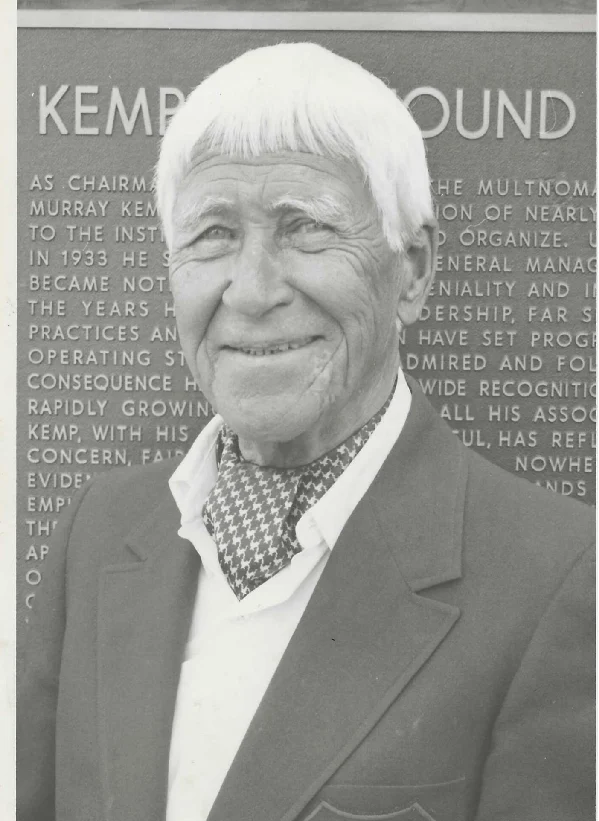
Throughout the years that fgllowed you ran Fairview Greyhound Park with consistency and honesty. The public came to expect that you would have some of the finest greyhounds avaliable for each season and they depended on the Kennel Club to entertain them. You accomplished this task so well that in 1978 both the Board of Directors and the public enthusiacially voted to change the name of Fairview to Murray Kemp Greyhound Park.
One month before this induction, October 1983, you were inducted into the Oragon Sports Hall of Fame, you continue to serve as an active president of the board at Multnomah. For these accomplishments, and more, to this Sport of Queens we proudly induct you into the Greyhound Hall of Fame.